Call for Price: 0086-15515573212
Sourcing a Paper Salad bowl in bulk is not just a price comparison. The right choice must hold crisp greens, resist dressing, and arrive without crushed rims or damp cartons. A sample may look sturdy on a desk, then soften after ten minutes with vinaigrette. Test it with the food and serving conditions you actually expect.
For transparency, the expert and quotation below are fictional and illustrative, not a verified industry interview. Packaging consultant Daniel Reed puts the guiding idea this way: “A bowl earns trust at the table, not on the spec sheet.” That means checking capacity, rim strength, leak resistance, stacking, print quality, and packaging consistency before placing a large order. Small details matter. Ask suppliers for material specifications, sample quantities, production timelines, and clear pricing at different order volumes. Confirm how the bowls are packed, so storage and transport do not undo their quality. If a supplier’s claims are vague, request measurable answers and records you can review.
The seven tips ahead will help you compare suppliers, assess samples, and spot cost trade-offs that a unit price can hide. They will also encourage a useful pause: are you choosing the bowl your customers need, or simply the cheapest one available? Test before scaling. Bulk purchasing rewards preparation, but no checklist can replace hands-on testing with your menu, staff, and service routine.
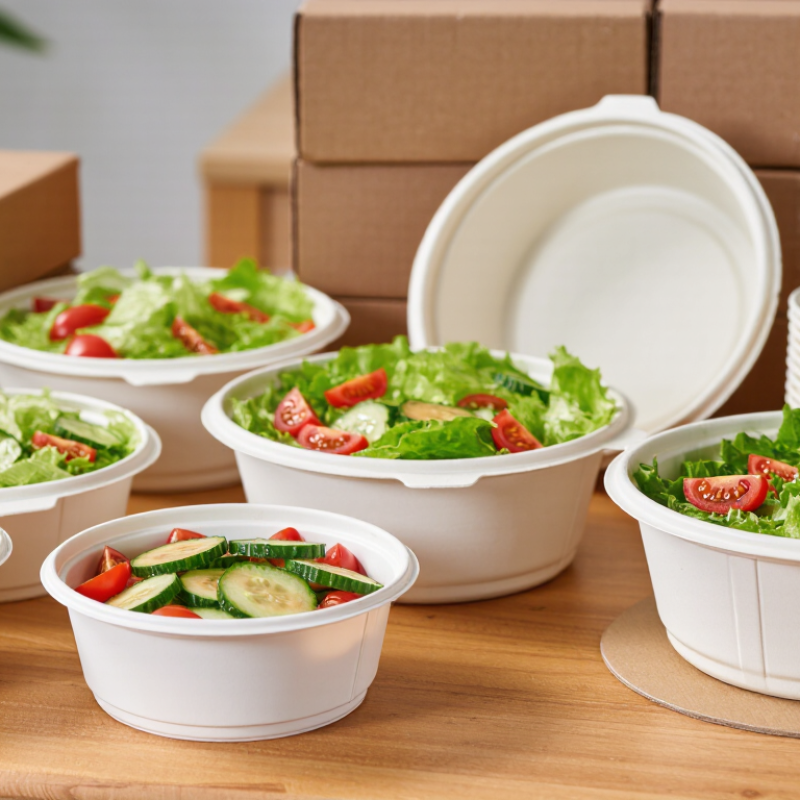
Define the bowl’s job before comparing prices. A chilled grain salad with vinaigrette needs different protection from a warm entrée with oily toppings. USDA Economic Research Service data show that food-away-from-home represented 58.5% of U.S. food spending in 2023. That figure is not a packaging forecast, but it underscores why takeout performance deserves attention. Fit matters. Specify rim diameter, usable capacity, and depth, then test a filled sample with the actual menu portion. A bowl that looks generous empty may leave little room for greens and toppings.
Record the service conditions: cold holding time, hot ingredients, dressing contact, and whether the bowl travels stacked in a delivery bag. Ask suppliers for material composition, coating details, and test evidence for leak resistance and heat performance. Confirm that lids fit securely, even after bowls are nested and separated repeatedly. For salad kits, check whether toppings stay distinct and the rim resists bending during handling. For local disposal claims, verify acceptance with the intended waste program; paper content alone does not establish recyclability. We often focus too heavily on unit cost. That can be a mistake. Compare landed cost per usable serving, including damaged bowls, lid mismatch, and storage space, before setting bulk quantities.
Compare bowl stock by performance, not just color. Virgin kraft often gives a clean, consistent surface; recycled-fiber options can vary more in shade and stiffness. Ask for the fiber percentage and a filled-sample test. A bowl that feels firm when empty may soften under hot, oily food. Size matters just as much: compare rim diameter, usable volume, and stack height, then test the bowl with your actual portions and lids. Small mismatches can slow a serving line.
Coatings change grease resistance and end-of-life options. Ask whether the lining is plastic, a dispersion coating, or another material, and request written specifications rather than relying on “eco-friendly” wording. The U.S. EPA’s 2018 Advancing Sustainable Materials Management report estimated a 68.2% recycling rate for paper and paperboard overall. That figure does not describe food-contaminated bowls, so don’t treat it as proof that a coated bowl is recyclable locally.
Not a small detail.
Compare suppliers on minimum order quantity, lead time, sample availability, and food-contact documentation. Request the same bowl size and coating from each supplier; otherwise, quotes are hard to compare. I would still test a full case before committing. One awkward fit can waste more than a low unit price saves.
When sourcing paper salad bowls in bulk, request current food-contact documentation for the exact bowl, lining, and intended use. A certificate for plain paper may not cover a coated version. Check that test reports identify the material and relevant conditions, such as contact with oily foods or chilled dressings. Ask how production lots are tracked, too. Paperwork should connect to the cartons you will receive, not just a generic product family.
Then test samples with real food. Leave vinaigrette in a bowl for the time customers might take to eat, and check for leaks, soft spots, or coating transfer. Small details matter.
Environmental claims need the same scrutiny. Ask what “compostable” means, which parts are included, and whether the claim depends on commercial composting conditions. A paper bowl with a plastic lining may not fit the disposal route available to your customers. Request supporting certification or test evidence, and confirm that local facilities accept the item. I have seen purchasing conversations focus on the paper itself and overlook the lid or lining. That is an easy gap to miss. If documentation is vague, pause before committing to a large order.
A low unit price can hide expensive freight, setup charges, or oversized cartons. Ask for a written quote at several order quantities, such as 1,000, 5,000, and 10,000 bowls. Compare the landed cost per usable bowl, not just the factory price. Check whether lids, printing, or packing changes the quote. Small details matter.
Minimum order quantities may apply per size, design, or production run. Confirm this before approving artwork or paying a deposit. If demand is uncertain, ask whether mixed sizes can share one order. Some suppliers will allow it; others will not. Request a sample carton and inspect bowl strength, rim shape, and nesting. A sample is helpful, but it may not match every production batch perfectly.
Delivery terms shape both cost and responsibility. Ask where the quoted price ends, who arranges transport, and who handles import paperwork where relevant. Get estimated production and transit times in writing, including the date they begin counting from. Check carton dimensions and pallet details, since storage space can become a real cost. Also clarify what happens if cartons arrive late or damaged. I would avoid relying on a verbal promise here; it is easy to remember it differently later.
| Tip | Dimension to Assess | What to Request or Compare | Practical Buying Check |
|---|---|---|---|
| 1. Compare like-for-like bulk pricing | Unit price, order quantity, and included items | Ask for written quotes at several quantities. Confirm whether lids, sleeves, printing, and freight are included or priced separately. | Compare the same bowl capacity, material, coating, lid fit, and packaging configuration across quotes. |
| 2. Confirm the minimum order | MOQ per size, design, and print version | Ask whether the minimum applies to the total order or separately to each bowl size, color, or custom-printed design. | Check that the MOQ fits expected usage and available storage; request any setup charges for smaller runs. |
| 3. Specify bowl performance | Capacity, dimensions, material, and intended food use | Request product specifications and samples. State whether bowls will hold cold salads, oily ingredients, or dressings, and whether lids are required. | Test samples with the actual menu and compatible lids before approving a bulk order. |
| 4. Verify food-contact documentation | Applicable regulations and supporting documents | Identify the destination market and ask for current food-contact compliance documentation relevant to the product and its intended use. | Check that documents cover the exact material, coating, and product configuration being quoted. |
| 5. Check production and delivery timing | Production lead time, dispatch date, and transit estimate | Request separate estimates for production and shipping, plus the date from which each estimate is measured. | Build in time for sample approval, artwork approval, customs processing where applicable, and receiving inspection. |
| 6. Clarify delivery terms and landed cost | Named delivery location, freight, duties, and unloading responsibilities | Ask which delivery term applies and what costs or tasks remain your responsibility. Request the delivery location in the quotation. | Compare estimated total cost to your receiving point, not just the quoted product price. |
| 7. Agree on quality checks and remedies | Inspection criteria, defect handling, and reorder consistency | Agree on acceptable dimensions, print placement if applicable, packaging condition, and the process for reporting shortages or defects. | Keep an approved sample and written specifications as references for delivery inspection and future orders. |
Note: Minimum order quantities, pricing, and lead times vary by supplier, product specification, order size, and destination. Confirm all quoted terms in writing.
Before placing a bulk order, request samples made with the same paper stock, barrier coating, and forming process planned for production. A polished showroom sample may not reflect routine output. Check the bowl’s diameter, depth, rim shape, and weight against your serving needs. Small variations can affect lid fit and stack stability. Measure several bowls, not just one.
Variation matters.
Test each sample with the food you actually serve. Fill it with hot soup, then check for softening, leaks, or a weakened base after a realistic wait. Try oily or acidic foods too, if they appear on your menu. Use a timer. Also test how bowls stack, travel in a delivery bag, and hold up during normal handling. Keep a few samples for comparison, and ask the supplier to document material specifications and acceptable tolerances. A sample is useful, but it cannot guarantee every production run will match. That part deserves a clear conversation before you approve the order.