Call for Price: 0086-15515573212
Choosing the best Manual Wrapping Machine in 2026 is less about finding the most advanced equipment and more about matching the tool to daily pallet work. A small warehouse wrapping 20 loads per shift has different needs from a distribution center handling hundreds. Load size, film width, operator height, and storage space all matter. So does the cost of inconsistent wrapping.
The wider packaging market provides useful context, though it does not directly rank manual dispensers. PMMI’s 2024 State of the Industry report describes continuing investment in packaging operations, including equipment and productivity improvements. That trend makes a practical question more important: can a manual wrapper reduce wasted film and keep loads stable without slowing the operator? On a busy loading dock, a comfortable handle and smooth film tension can matter more than a long feature list. Small details count.
This guide compares manual wrapping machines by control, durability, ergonomics, and value. It also considers common use cases, from occasional warehouse shipping to frequent pallet preparation. No single model is best for every team. Product claims should be checked against specifications, warranty terms, and real operating conditions; a tool that feels light in a showroom may behave differently after a full shift. That is worth remembering. The right choice should make wrapping more consistent, while remaining simple enough for staff to use correctly.
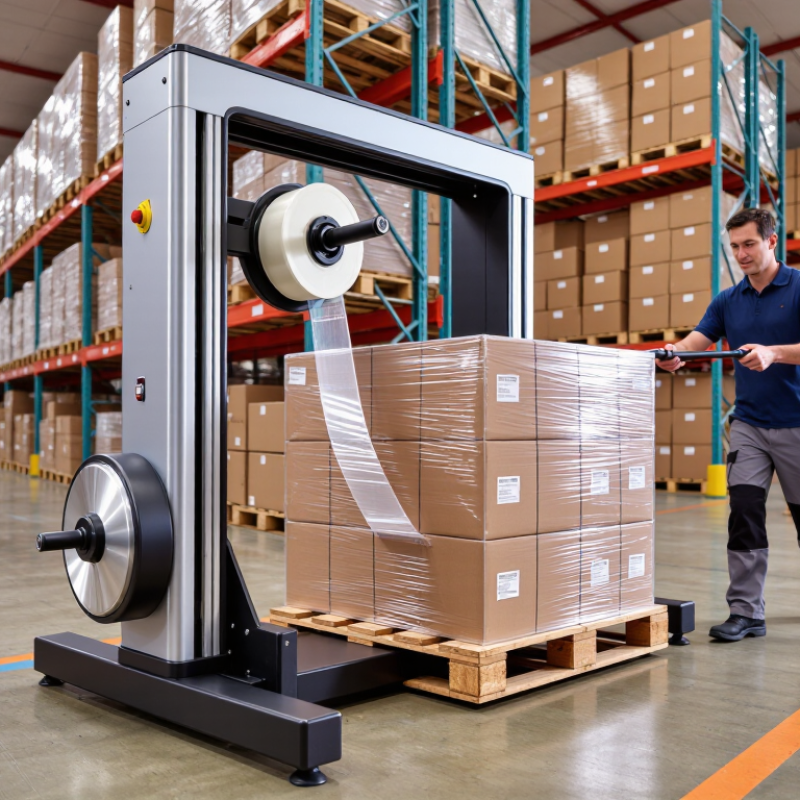
A manual wrapping machine is a hand-operated turntable or rotating-arm system that applies stretch film around a palletized load. The operator positions the goods, attaches the film, and controls rotation and film tension. Unlike a fully automatic wrapper, it relies on human judgment at each stage. The goal is a stable unit load: cartons, totes, or other items secured together for storage and transport. Consistent wrapping can reduce shifting, but film alone cannot correct a poorly stacked pallet.
Its role is practical where output is modest, floor space is limited, or load sizes vary. MHI’s 2024 Annual Industry Report identifies robotics and automation as a major investment area for supply-chain organizations; that trend offers context, not proof that every site needs automation. A manual machine may suit smaller operations, though the operator’s technique can vary. That matters. Uneven overlap or excessive tension may damage cartons or waste film. The machine is a tool, not a substitute for load testing.
Tips: Match the turntable capacity to the heaviest pallet you handle. Check film tension and overlap on several load types, then inspect for loose corners and crushed boxes. Keep a simple record of film use and load stability. Small trials help; they are not perfect.
The best manual wrapping machine depends on pallet weight, shape, and daily volume. Handheld dispensers suit occasional wrapping and irregular loads; the operator walks around each pallet and controls film tension by hand. That flexibility has a cost: repeated bending and pulling can tire wrists and shoulders. Turntable systems keep the pallet rotating, so the operator can apply film from a steadier position. They are often more practical for heavier, uniform loads, provided the pallet fits the table’s rated capacity. No single load-size cutoff works for every setup.
The U.S. Bureau of Labor Statistics recorded 2.6 million nonfatal workplace injuries and illnesses in private industry in 2023. This figure is not specific to wrapping, but it reinforces the value of reviewing repetitive tasks and awkward reaches.
A turntable may reduce walking around a load, yet loading and unloading still require care. The right choice depends on actual pallet dimensions, film use, floor space, and operator capability—not just purchase price. I would test both methods on a typical shift; a neat demonstration pallet can be misleading.
Tips: Compare the effort needed to wrap one full pallet, including corners and the final film cut. Check rated load capacity before buying, and watch for shoulder strain during a short trial.
A manual wrapping machine is only as dependable as its film settings and operator technique. ASTM D4649 is a guide to selecting and using stretch-wrap films, not a test method. Pair its guidance with ASTM D5458, which measures film cling through a peel-force test. That result helps compare how firmly two film layers hold together. It does not prove that a wrapped load will survive every route or warehouse condition.
The U.S. Environmental Protection Agency reported that plastic packaging generated 14.5 million tons of waste in 2018, with about 2.2 million tons recycled. This broad category is not limited to stretch film, but it shows why reducing unnecessary film matters. During a machine trial, record film gauge, pre-stretch setting, wrap count, and D5458 cling results. Then check a real pallet: look for loose corners, crushed cartons, and film tails that lift after handling. Lab figures help, but they do not replace a practical load check.
Tips: Keep the film sample, test direction, and conditioning consistent. ASTM D5458 results can shift with test conditions. Try two settings. Repeat the wrap test after changing one variable, such as tension, and note any awkward hand effort. Manual wrapping is still operator-dependent; that is a limitation worth recording, not hiding.
A manual wrapping machine should reduce awkward reaches, not merely make film application faster. Treat the 30-inch figure as a screening cue, not a universal OSHA pass-or-fail limit. OSHA guidance emphasizes evaluating the task, load, posture, and frequency together. A roll held far from the body can strain a worker even when it feels light.
Check where the film roll sits and how workers replace it. Can they lift it close to their torso, without twisting or reaching above shoulder height? A waist-level holder and a stable, easy-to-turn handle may help. So can a low-profile turntable that avoids repeated deep bending. Test it with the actual roll. Small design details matter.
Observe a full shift, not just a demonstration. Note how often workers bend, pull, and walk around the load, and whether the floor is clear and level. Ask operators where they feel strain; their answers may reveal problems a checklist misses. No single machine makes every lift safe. Reassess when roll weights, packaging, or work pace change.
| Rank | Manual wrapping setup | Ergonomic and safety considerations | How it relates to a 30-inch reach | Best-fit conditions | Overall assessment |
|---|---|---|---|---|---|
| 1 | Manual turntable stretch wrapper | The turntable rotates the pallet, reducing the need for the operator to walk around it while applying film. A suitable machine height and safe loading method are important; loading and unloading may still involve manual handling. | Can reduce repeated reaching around the pallet during wrapping, but does not by itself ensure that lifting or film application stays within a safe reach. | Regular pallet wrapping where a stable, level installation and safe pallet-loading method are available. | Often the strongest manual option for reducing walking and repeated twisting during the wrapping cycle. Evaluate loading, unloading, and access separately. |
| 2 | Manual rotary-arm stretch wrapper | The arm moves the film around a stationary load, so the operator may not need to walk around the pallet. The load must be stable, and the rotating arm requires suitable guarding and a clear operating area. | May reduce operator travel and reaching during wrapping; it does not establish a safe lifting distance for placing or removing the load. | Loads that should remain stationary during wrapping, provided the equipment is properly installed and safeguarded. | Potentially ergonomic when the process keeps the worker outside the rotation path and manual load handling is controlled. |
| 3 | Hand-held film dispenser used while walking around a pallet | Requires the operator to move around the load and repeatedly reach, bend, or turn. The actual demands vary with pallet dimensions, film height, load shape, and work pace. | A wide load or poor access may require reaching farther than is comfortable. A 30-inch reach should trigger an assessment, not be treated as a universal safe limit. | Occasional wrapping, low volumes, or locations where powered equipment is impractical. | Lowest equipment cost, but generally offers the least assistance in reducing walking and awkward postures. |
| 4 | Hand-held dispenser with a pallet jack or other manual load rotation | Rotating the load may reduce walking around it, but moving or repositioning a pallet introduces pushing, pulling, stability, and clearance considerations. Use only equipment and methods suitable for the load and floor conditions. | May reduce repeated reaches around the load, but does not make a 30-inch lifting reach acceptable or remove lifting risks. | Work areas where a pallet can be repositioned safely and the equipment is appropriate for the task. | Can improve access in some layouts, but the handling method should be assessed as a whole rather than judged by wrapping reach alone. |
| Important guidance note: OSHA does not prescribe a universal “30-inch manual-lifting limit.” The Revised NIOSH Lifting Equation uses horizontal hand distance as one factor; its horizontal multiplier is based on a 10-inch reference distance, and the equation is not applicable when the horizontal distance exceeds 25 inches. A 30-inch reach is therefore not an OSHA safe/unsafe cutoff. Assess the complete task, including load weight, reach, lift height, twisting, frequency, and coupling, and consult qualified safety or ergonomics personnel when needed. | |||||
The best manual wrapping machine in 2026 is not necessarily the fastest one. Match its capacity to your daily pallet count, load shape, and available labor. A small warehouse wrapping 15 pallets per shift may value simple controls and easy film changes more than extra speed. Keep it practical.
Load stability matters as much as throughput. A machine should let operators apply consistent tension without crushing cartons or leaving loose film near the pallet base. Test it with your actual loads: tall boxes, uneven layers, and slippery packaging can behave differently from neat sample stacks. Check whether the turntable or rotating arm suits your floor space and pallet sizes. One awkward corner can slow the whole routine.
Total cost includes more than the purchase price. Account for film use, maintenance, operator time, training, and downtime. Ask suppliers for clear cycle-time and service estimates, then compare them against your own shift data. A lower-cost machine may become expensive if it needs frequent adjustment. The estimate can still be wrong. That is worth admitting. Before deciding, run a trial with representative loads and record film consumption, wrapping time, and any damaged cartons. A simple log often reveals more than a polished specification sheet.